
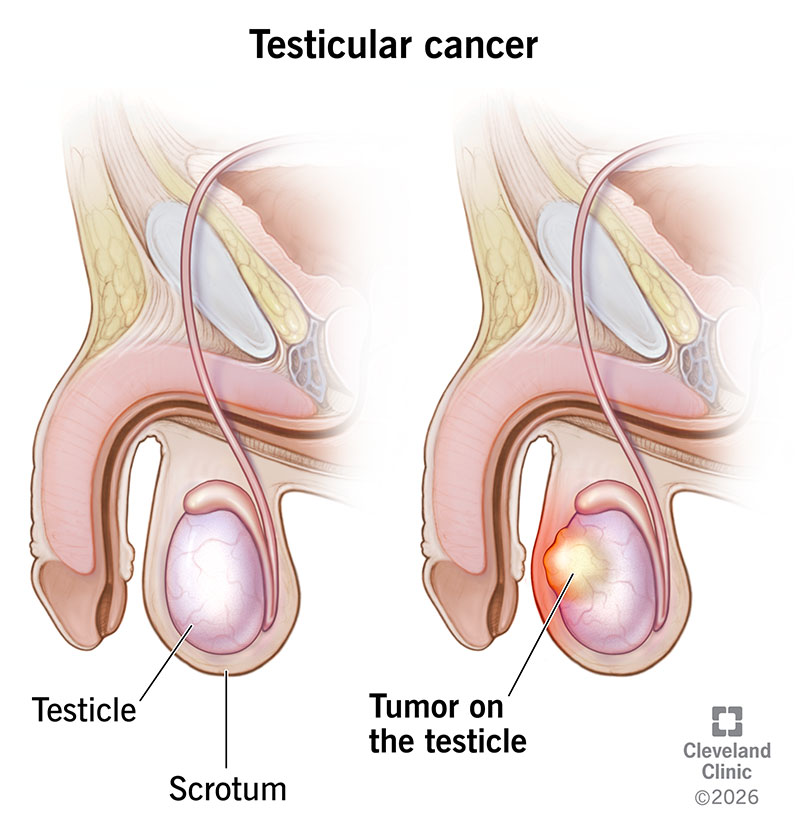
Testicles are not perfectly identical, and one commonly hangs lower than the other. A new change in shape, firmness, size, surface feel, or swelling is different because it may reflect a change within the testicle or surrounding scrotal structures.
Many causes are not cancer, but unexplained changes should still be examined.
Which Testicular Changes Are Worth Noticing?
Useful observations include a new lump, a firmer area, enlargement, shrinkage, swelling, heaviness, or a noticeable change in how one testicle feels compared with its usual state.
The National Cancer Institute includes a painless lump or swelling and a change in how a testicle feels among possible testicular cancer symptoms, while emphasizing that other conditions may cause similar findings.
That distinction matters. A symptom deserves evaluation without automatically predicting the diagnosis.
What Else Can Change Testicular Shape or Size?
Fluid around the testicle, enlarged scrotal veins, infection, inflammation, injury, cysts, and other benign conditions can change the apparent size or contour of the scrotum.
People often browse body-awareness articles after discovering an unfamiliar physical change. General reading may help someone describe what they noticed, but it cannot determine whether the change is inside the testicle or in surrounding tissue.
Physical examination and ultrasound can often provide much clearer information.
Does Pain Tell You Whether a Change Is Serious?
Not reliably. Some important testicular conditions can be painful, while others may cause little or no discomfort.
Fear after finding a lump can also lead to repeated checking, and some readers turn to anxiety-management reading while waiting for evaluation. Reducing anxiety is useful, but reassurance should come from appropriate examination rather than repeated self-checking.
A painless change should not be dismissed simply because it does not hurt.
| Change | Possible Context | Next Step |
|---|---|---|
| New hard lump | Testicular abnormality | Arrange prompt assessment |
| Soft swelling | Fluid or other scrotal cause | Clinical examination |
| Enlarged veins | Possible varicocele | Discuss if new or symptomatic |
| Sudden painful change | Possible acute problem | Seek urgent care |
How Are New Testicular Changes Checked?
A clinician may compare both testicles, examine surrounding structures, and ask about pain, injury, infection symptoms, fertility concerns, or how quickly the change developed.
General wellness information can help people become more attentive to body changes, but it cannot distinguish a harmless scrotal finding from a condition requiring treatment.
Ultrasound is commonly used when examination does not fully explain a lump, swelling, or change in testicular structure.
Why One Change Isn’t Enough for Self-Diagnosis
People sometimes assume every lump is cancer. Others assume a painless change must be harmless. Neither shortcut is reliable.
The epididymis, veins, fluid collections, and other structures can feel unfamiliar and may be mistaken for a testicular mass. At the same time, clinically important changes may cause little discomfort. The safer approach is to notice what is new and let an appropriate examination determine what it represents.
Red Flags That Need Prompt Attention
Seek prompt medical evaluation for a new testicular lump, unexplained swelling, increasing firmness, persistent enlargement, or another clear change from your normal anatomy.
Sudden severe testicular or scrotal pain needs urgent medical attention because interruption of blood flow from testicular torsion is an emergency. Significant swelling after injury, especially when pain continues, also deserves rapid assessment.
Frequently Asked Questions
Is it normal for one testicle to hang lower?
Yes. Mild natural asymmetry is common. A new change in position, size, firmness, or shape is more important than a longstanding difference.
Are all testicular lumps cancerous?
No. Cysts, fluid collections, enlarged veins, inflammation, and other conditions can produce lumps or swelling. A new lump should still be examined.
Can an ultrasound identify a testicular problem?
Ultrasound is commonly used to examine the testicle and surrounding scrotal structures. It can help clinicians distinguish different types of masses or swelling.
Check New Changes Instead of Guessing
Knowing your usual anatomy makes it easier to recognize a meaningful change, but self-examination cannot determine the diagnosis.
If a lump, swelling, shape change, or firmness difference is new and remains present, arrange a medical evaluation. Prompt checking provides far more useful information than repeatedly comparing symptoms with pictures or descriptions online.
This article is for general informational purposes and is not a substitute for professional medical advice, diagnosis, or treatment.